
Murky pond water can be frustrating, and figuring out how to clear murky pond water without chemicals isn’t always straightforward. Cloudiness can have several different causes, so it helps to understand what may be happening before deciding how to tackle it.
Your fish and the pond’s overall condition can offer useful clues. In this guide, we’ll look at what to consider when your water turns cloudy and how to approach the problem carefully.
What Should You Do First?
Start by checking the fish, testing the water, and restoring flow. Once those basics are stable, you can use fine mechanical filtration to catch the particles already in suspension.
Check Fish and Test the Water
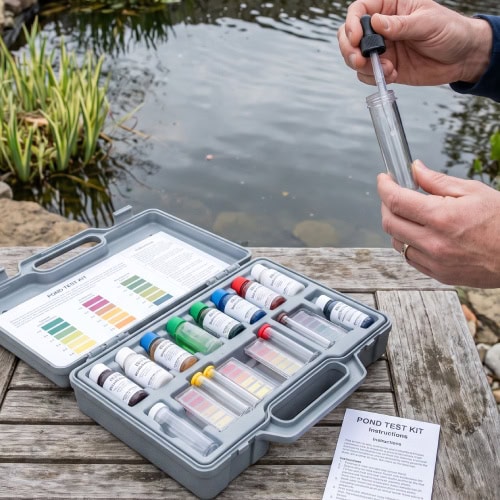
Watch your fish for surface gasping, unusual stillness, or a sudden loss of appetite. If they are gasping, increase aeration and check that the pump is running; dissolved oxygen is the immediate concern.
Use a pond testing kit to check ammonia, nitrite, and pH, and test dissolved oxygen if you have the equipment. Keep a record of the results so you can tell whether conditions improve after cleaning.
If ammonia or nitrite is detectable in a fish pond, pause feeding while you investigate filtration and water quality. Don’t let a clearer view of the bottom distract you from those readings.
Remove Floating Debris and Restore Water Flow

Scoop out leaves, uneaten food, and floating clumps of algae with a net. Empty the pond skimmer basket and clear debris from pump guards so water can move through the existing filter. If falling leaves are a recurring problem, pond netting stretched securely above the water catches them before they sink; keep it taut so wildlife cannot become trapped.
Avoid dragging a net through bottom sludge during this first pass. You want to remove material that is still easy to reach without sending a fresh cloud through the pond.
Filter Suspended Debris for Faster Clarity

- EXCLUSIVELY MADE FOR KOI PONDS: Crafted with care, our 1-inch thick filter pads provide exceptional mechanical filtration for crystal-clear...
- CRYSTAL CLEAR POND WATER: Place these pads in flowing water (like your pond skimmer box) to trap and remove uneaten food, waste, decaying...
- CUT TO FIT: Proudly made in the USA, our bulk filter pads are easily customizable. Save money by cutting them to your desired size...
For a small pond, polyester quilt batting placed in a filter basket or other secure chamber can catch fine particles that coarse filter pads miss. Position it where water passes through the batting, with a protected overflow route if it clogs. Check it frequently and rinse or replace it when flow slows; never leave loose batting near a pump intake or where fish can reach it.
This is a way to clear cloudy pond water while the filter runs. It removes particles passing through the batting, so the speed of improvement depends on circulation, pond size, and whether new debris keeps entering the water.
What Is Making the Pond Murky?
Identify the color and behavior of the haze before choosing a fix. Green water points toward suspended algae; brown water suggests soil particles or decaying organic material.
| Water Appearance | Likely Cause | Recommended Natural Action |
|---|---|---|
| Uniform green haze | Suspended algae bloom | Reduce feeding, add shading plants, and boost biological filtration. |
| Tea-colored brown | Decaying leaves and organic debris | Net out debris, vacuum bottom sludge, and rinse mechanical filters. |
| Muddy brown plume | Soil runoff or stirred sediment | Stabilize edges, redirect runoff, and add fine filter batting. |
| Persistent gray or white cloud | New pond or overwhelmed bio-filter | Reduce feeding, test water parameters, and allow bacteria to mature. |
Is Green Water an Algae Bloom?
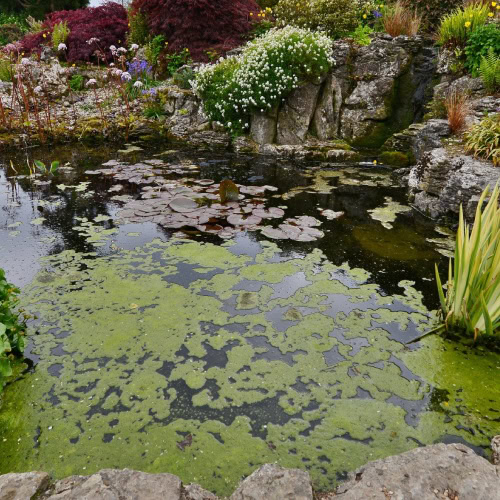
If the water looks uniformly green and you cannot see distinct particles drifting through it, suspended algae may be responsible. Sunlight and excess nutrients from fish waste, food, or runoff support algae growth. A bloom can also affect oxygen levels, particularly when algae die and decompose.
Look at what changed before the water turned green: heavier feeding, more direct sun, or a filter that stopped moving water. Removing visible string algae helps with that separate problem, but it will not remove the microscopic algae coloring the water. Green pond water needs sustained nutrient control and effective filtration.
Is Brown Water Sediment or Decaying Debris?

Brown, tea-colored water after leaves accumulate points toward decaying plant matter. A muddy plume after rain, digging, or fish rooting along the bottom points toward disturbed soil. These need different fixes: remove organic debris from the first and keep soil out of the second.
You can fill a clear jar with pond water and leave it undisturbed. Grit that settles leaves clearer water above it; fine clay can remain suspended much longer. This simple check helps you judge whether turbidity in pond water comes from particles your filter can catch or an ongoing source of erosion.
Is the Pond New or the Filter Overwhelmed?

A new pond has yet to establish a mature biological filter. Its water may change appearance while fish waste and other nutrients accumulate, so test it regularly and feed lightly during this period.
In an established pond, check for clogged filter media, reduced pump flow, or waste collecting faster than the system removes it. Fish stirring the bottom can keep even a well-filtered pond cloudy. Note when the haze returns after a cleaning: an immediate return suggests particles are still being stirred up or washed in.
Which Natural Fix Matches the Cause?
To clear murky pond water naturally, remove the material feeding the problem and support the pond’s existing filtration. Sediment calls for careful removal and erosion control; green water calls for nutrient control, plants, and steady biological filtration.
Remove Sludge Without Stirring Up More Sedimen

- Max. Suction depth: 6 ft.
- High-power suction to a depth of 59 inch.Maximum suction depth of 78 inch.Suction hose length: 13 ft
- Power consumption: 1200-1400w
Use a pond vacuum to lift settled sludge from accessible areas in small passes. Move the nozzle slowly along the bottom, especially near fish and planting baskets. Stop if you create a dense cloud, and let the water settle before continuing.
You can do substantial pond cleaning without draining the water. Remove rotting leaves by hand or net first, then vacuum the deposits beneath them. Leave stable planted areas and wildlife habitat undisturbed unless accumulated waste is causing a problem.
Support Bacteria and Biological Filtration

- Once applied, Pondworx Bacteria will instantly SUPER charge bacteria that get to work on your behalf
- This concentrated formulated is designed for large ponds but also works great in water gardens, koi ponds and other water features
- Treated bodies of water may be used for recreation, fishing, and other activities immediately after applying
Biological filtration gives nitrifying bacteria surfaces to colonize. These bacteria process fish waste as water moves through the filter, so protect both the filter media and its water flow. Rinse clogged media gently in a bucket of pond water, and avoid cleaning every biological media piece at once.
Check the pump and filter again after cleaning to confirm water is circulating. Adding a bacteria product does not replace a working filter or correct excess fish food; existing bacteria need adequate surface area, oxygen, and time. Keep testing ammonia and nitrite as you make changes.
Use Plants and Stable Edges to Limit Algae and Runoff

- The first reason why the Hornwort is a good aquarium plant is purely aesthetic. It looks beautiful in tanks and adds a nice bit of color...
- Then, another benefit of having a Hornwort plant in your aquarium is that it creates more oxygen, which oxygenates the tank for your fish...
- The Hornwort plant also sways the current, so it gives the water current in your fish tank a new dynamic. Plus, it improves the water’s...
Aquatic plants take up nutrients and provide shade that limits sunlight reaching the water. Choose plants suited to your pond and manage their growth so the surface remains open for gas exchange. Remove dying foliage before it sinks and becomes another source of nutrients. Plants that clean water are most useful alongside sensible feeding and filtration.
For muddy runoff, redirect downspouts away from the pond and stabilize exposed soil near the edge with suitable planting or stone. If rain regularly washes soil into the water, filtering the pond alone will leave you repeating the same cleanup.
When Is Natural Flocculation Appropriate?

- Binds problem causing phosphate
- Provides approximately 70 beneficial trace minerals
- Buffers pH levels
Flocculation groups tiny suspended particles into larger clumps that can settle or be filtered out. It is relevant when fine clay stays cloudy after the larger grit has settled and you have already controlled the incoming soil.
Natural flocculants still add a treatment to the pond, so they do not fit a strictly treatment-free approach. Their suitability depends on the material, your water chemistry, and whether fish or other wildlife use the pond
. If you are considering gypsum for clearing pond water, test the water and identify the sediment first; avoid adding any material based on cloudiness alone.
How Do You Keep the Water Clear?
Keep nutrients and loose debris out of the pond, then maintain enough flow and filtration to handle what remains. Make these checks part of regular pond maintenance, especially after heavy rain or a change in fish feeding.
Limit Fish Food, Fertilizer Runoff, and Falling Leaves

- 【3 IN 1 POND NETTING PROVIDE EXTREMELY PROTECTION】: BUZIFU Pond net kit package include: 1 15x20ft pond netting, 14 ground stakes...
- 【DENSE 3/8 INCH WOVEN FINE MESH POND NETTING & UV PROTECTION】: The pond netting for koi ponds has a 3/8 inch mesh size prevents the...
- 【DURABLE AND STURDY POND & POOL NETTING】: Our pond netting cover made of high-density polyethylene material, very soft and easy to...
Feed only what your fish consume promptly, and remove leftovers you can see. Keep lawn fertilizer and soil-laden runoff from reaching the pond. During leaf fall, empty nets and skimmer baskets before the trapped material starts to break down.
Notice where waste collects after wind or rain. A sheltered corner that repeatedly fills with leaves is a useful place for more frequent netting, while a muddy inlet needs an edge or drainage fix.
Maintain Filtration and Monitor Water Quality

- Powerful 18 watt UV bulb for maximum cleaning results in a crystal clear pond by eliminating green water
- Easily integrates into an existing or new pond system
- For best results, connect to an OASE BioSmart biological filter
Check pump flow and clean mechanical filter media before it becomes packed with debris. Preserve biological media during routine cleaning, and keep a record of ammonia, nitrite, pH, and visible changes in the water.
If the pond clouds again, note its color and what happened beforehand. Green haze after heavier feeding points you back to nutrient inputs; a brown plume after rain points you toward runoff. Those observations give you a specific place to correct the problem before repeating the cleanup.