
The Amazon Rainforest is the world’s largest tropical rainforest, stretching across more than 5.5 million square kilometers and touching nine South American countries. Within this sprawling green maze, there are somewhere between 40,000 and 60,000 plant species – an absolutely wild number, if you think about it! The dense, tangled vegetation here has forced plants to come up with some fascinating survival tricks just to get by.
Getting to know the plants that call this place home really shows off just how much variety and ecological magic the Amazon holds; from massive canopy trees to delicate aquatic species. Some of these plants provide food and materials you’d recognize, while others have been used as medicine for countless generations.
Every plant here, from the most unassuming shrub to the giants overhead, plays its part in keeping the rainforest humming along, supporting wildlife and even helping regulate the planet’s climate.
1) Cacao Tree (Theobroma cacao)
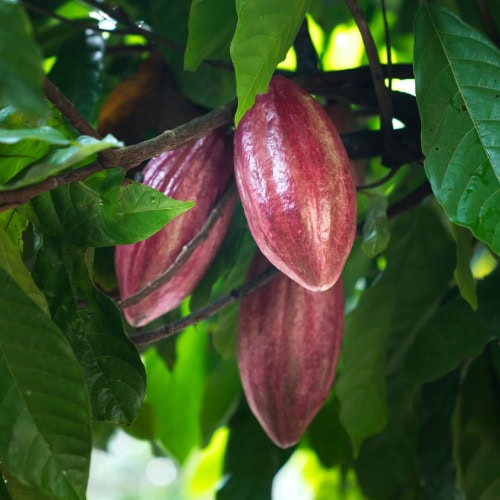
The cacao tree is a small evergreen, usually topping out at 6 to 12 meters, tucked away in the Amazon’s understory. Its name, Theobroma cacao, literally means “food of the gods.”
This tree likes it hot and humid, somewhere between 80 and 90 degrees Fahrenheit. It prefers to stay in the shade of bigger trees, soaking up gentle, dappled light from above.
Its seeds are the famous cocoa beans, the very heart and soul of chocolate!
2) Brazil Nut Tree (Bertholletia excelsa)
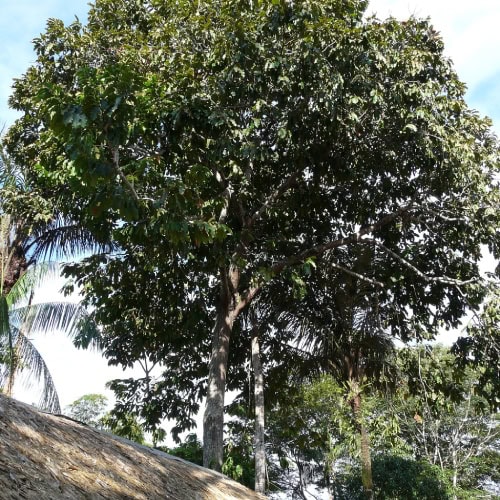
The Brazil Nut Tree is a true Amazonian giant, sometimes shooting up to 160 feet. You’ll spot these towering trunks scattered through Brazil, Bolivia, Peru, and a few neighboring spots.
Its trunk can be massive, up to 6 feet thick, and only branches out way up in the canopy. The tree’s large, nutrient-packed seeds are a crucial food source for both wildlife and people living in the rainforest.
3) Rubber Tree (Hevea brasiliensis)
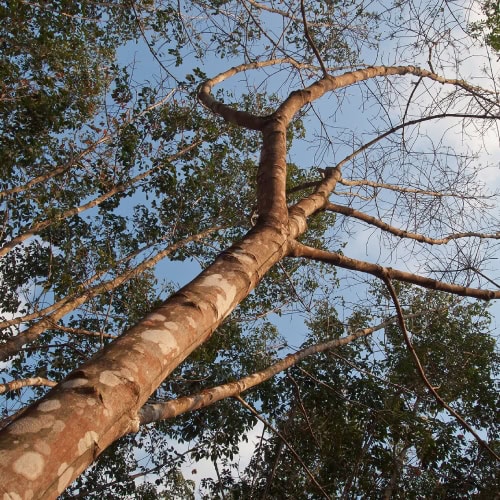
The Rubber Tree is native to the Amazon basin – think Brazil, Venezuela, Ecuador, Colombia, Peru, and Bolivia. These trees do best in low-altitude moist forests, wetlands, and along riverbanks.
It’s famous for its milky latex, which is the world’s main source of natural rubber. In the wild, these trees can reach 30 to 40 meters and live well over a century.
4) Kapok Tree (Ceiba pentandra)
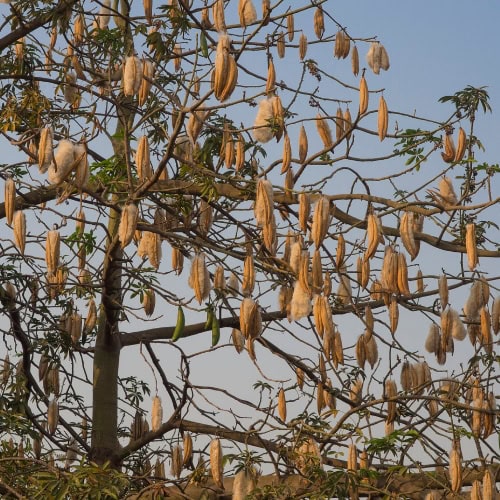
The Kapok tree is one of the Amazon’s skyscrapers, sometimes soaring up to 200 feet. Its trunk is thick with dramatic buttresses at the base, and you might notice spines or thorns along its bark depending on the variety.
This tree often sticks out above the canopy, spreading a wide, umbrella-like crown. In the right conditions, it can shoot up more than 13 feet a year, making it a fast-growing titan that dominates the skyline.
5) Heliconia (Heliconia rostrata)
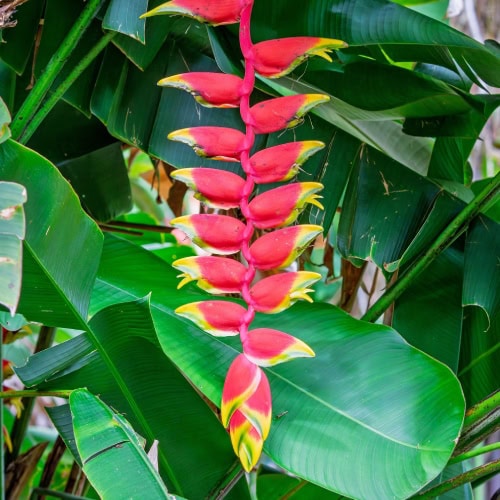
Heliconia rostrata, or the hanging lobster claw, is impossible to miss with its bold, drooping flower clusters; fiery red and yellow bracts that look like a lobster’s claw or a parrot’s beak.
This plant thrives in humid, tropical corners of the Amazon, from Colombia to Peru. Its big, leathery, banana-like leaves can stretch up to four feet, all sprouting from underground rhizomes.
6) Mahogany (Swietenia macrophylla)
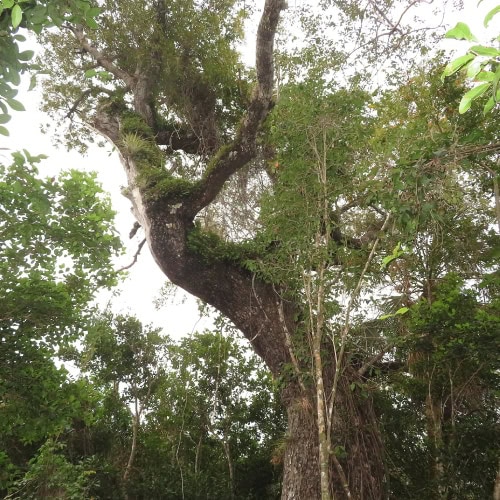
Mahogany trees reach for the sky in the Amazon, sometimes hitting 200 feet and living for centuries. Their reddish-brown wood is legendary and sought after worldwide.
You’ll find them scattered in small groups, often along fertile riverbanks or in mixed hardwood forests. Mahogany is a key player in the rainforest, not just for its wood but for the role it plays in the ecosystem.
7) Virola Tree (Virola spp.)
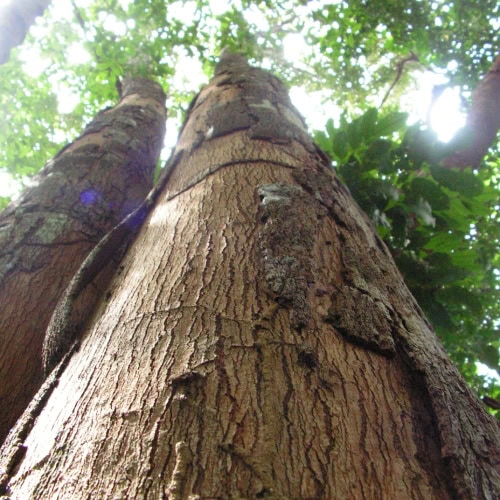
Virola trees are medium-sized members of the nutmeg family, scattered throughout the Amazon. The genus has about 60 species, native from southern Mexico all the way to southern Brazil.
They’re easy to spot with their shiny, dark green leaves and clusters of tiny yellow flowers. Virola trees often grow in the canopy, especially in lowland and cloud forests, and are among the most common trees in Amazonia.
Many indigenous groups have found all sorts of uses for Virola species. The trees can get up to 20 meters tall and are important for the forest’s health.
8) Guarana Plant (Paullinia cupana)
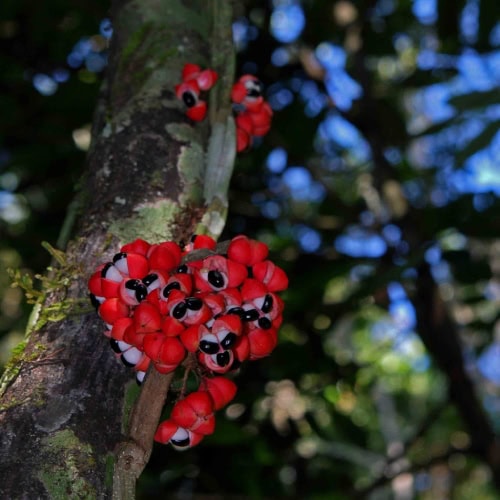
The guarana plant is a woody climbing shrub, native to the Amazon basin and especially common in Brazil. Part of the Sapindaceae family, it can climb up to 13 meters as it weaves through the rainforest canopy.
It’s most at home in humid lowlands up to 800 meters elevation. The plant’s big leaves have five leaflets, and it puts out clusters of small white flowers. The grape-sized fruit is packed with caffeine, which is probably what you’ve heard about most.
9) Strangler Fig (Ficus spp.)
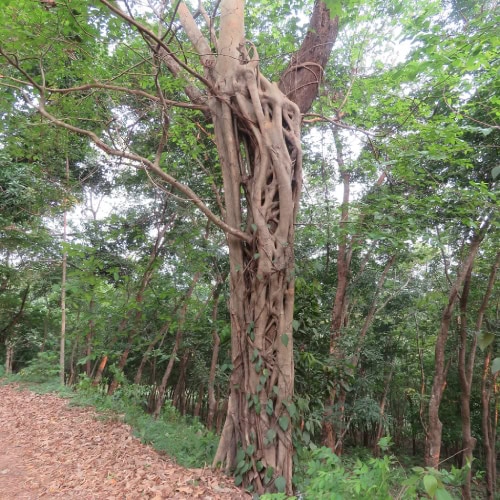
The strangler fig starts its life way up in the canopy, usually after a bird drops its seed on another tree. It sends roots downward and wraps around its host as it grows.
This often leads to the host tree’s eventual demise, but the fig is crucial for the ecosystem. Its fruit is available year-round, even during dry spells when food is hard to find for rainforest animals.
There are over 800 Ficus species in the tropics, and they support everything from monkeys to birds.
10) Bromeliads (Bromeliaceae family)
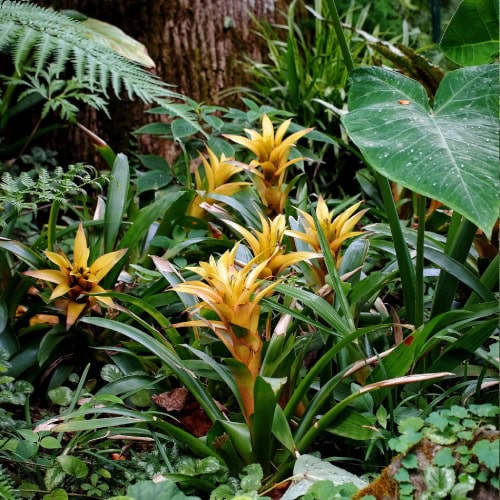
Bromeliads are a wildly diverse family, over 3,000 species, native to the Americas’ tropical and subtropical zones. In the Amazon, they’re everywhere: some cling to trees as epiphytes, others grow on the forest floor.
This family includes the pineapple, but in the rainforest, many bromeliads form leafy rosettes with central cups that collect water. These little pools become microhabitats for frogs, insects, and all sorts of tiny creatures.
11) Liana Vines
Liana vines are woody climbers that start as small shrubs on the forest floor. They shoot out long, twisting stems that latch onto trees, using them to reach the canopy and sunlight. These vines connect the forest’s layers and give animals an aerial highway through the trees.
Lianas offer up fruits and flowers for a variety of rainforest creatures. There are more than 2,500 species of these climbers in the tropics, making them a signature piece of the Amazon landscape.
12) Euterpe Palm (Euterpe oleracea)
The Euterpe palm, or açaí palm, is right at home in the Amazon’s swamps and floodplains. It’s a slender palm, growing over 20 meters, and produces the açaí berry – a small, dark purple fruit beloved by wildlife like macaws, parrots, and monkeys.
This palm grows thickly in flooded areas, especially in Brazil’s Pará state. It’s valuable for its fruit and edible hearts of palm, supporting both local diets and economies.
13) Amazon Water Lily (Victoria amazonica)
The Amazon Water Lily is one of the rainforest’s showstoppers. Its round leaves can stretch up to 10 feet wide, floating on the water with rims that curl up 3 to 6 inches.
These leaves are held up by underwater stalks up to 26 feet long, and the plant puts out big, eye-catching flowers that start white and turn pink, usually blooming from July to August.
Indigenous people have long used the seeds as food, grinding them into flour. You’ll find these lilies in the calm backwaters all over tropical South America.
14) Balsa Tree (Ochroma pyramidale)
The balsa tree, native to South American rainforests, is famous for its incredibly light wood. It grows at breakneck speed, up to 30 meters in less than 15 years, making it one of the fastest growers in the Amazon.
Balsa trees do well in clearings and along streams, and their wood is prized for being strong yet feather-light.
15) Chicle Tree (Manilkara zapota)
The Chicle Tree is an evergreen native to southern Mexico and Central America, but it’s also a fixture in lowland rainforests. It usually grows 30 to 60 feet tall in cultivation, though wild trees can reach 100 feet.
This tree produces a gummy latex called chicle, which has about 15% rubber and 38% resin. For a long time, chicle was the main ingredient in chewing gum, before everything went synthetic.
16) Palo Santo Tree (Bursera graveolens)
The Palo Santo tree, or Bursera graveolens, comes from tropical dry forests in South America – Peru, Ecuador, Colombia, and Venezuela all have their own populations.
Its name means “holy wood” in Spanish, hinting at its deep cultural roots. Indigenous groups have used Palo Santo for spiritual and medicinal purposes for ages.
The wood gives off a unique scent when burned, which is why it’s so popular as incense. You’ll know this tree by its fragrance more than anything.
17) Nauclea Tree (Nauclea diderrichii)
The Nauclea tree, also called bilinga or opepe, is evergreen and can reach 30 to 40 meters. Its straight trunk rises 20 to 30 meters before branching out into a broad, rounded crown.
The tree is harvested for its high-quality timber. Its bark is light brown to yellowish with shallow cracks, and the wood inside turns pale brown when exposed.
18) Sangre de Drago Tree (Croton lechleri)
The Sangre de Drago tree grows throughout the northwestern Amazon – think Peru, Ecuador, and Colombia. It’s a medium to large tree, usually 10 to 20 meters tall with a slender trunk.
Its claim to fame is the thick red latex that oozes from its bark, sometimes called “dragon’s blood.” Indigenous communities have used this crimson sap medicinally for generations, especially for wounds and skin issues.
19) Asai Palm (Euterpe precatoria)
The Asai Palm is a slender, evergreen palm native to the Amazon. It’s usually found in lowland, often flooded areas, such as swamps, riverbanks, and the like, all across Brazil, Peru, Colombia, and other countries.
This palm can reach 45 to 90 feet, sporting a thin trunk and a curtain of 5 to 20 long, arching leaves—pretty hard to miss in the understory.
20) Cepa Tree (Pentaclethra macroloba)
The Cepa tree, or Pentaclethra macroloba if you’re feeling scientific, is a big leguminous tree that calls the wet tropics of the northern Neotropics home. You’ll spot it mostly from Nicaragua down into South America, hanging out in seasonally flooded areas.
It’s not shy about size, either; this tree shoots up to 40 meters tall and sometimes takes over whole patches of swamp forest, forming these almost single-species stands. Locals have found plenty of uses for it, from medicinal remedies to food, depending on what’s needed.