
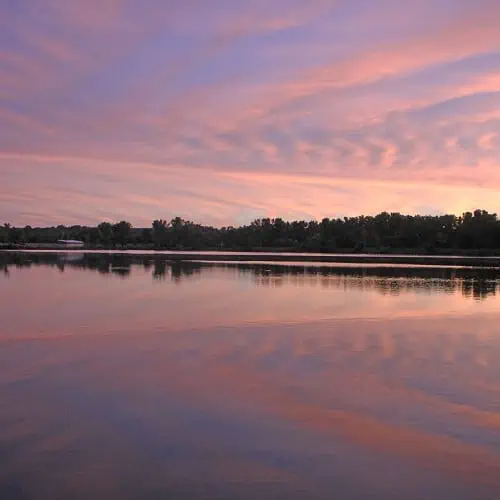
Milford Lake is Kansas’ largest man-made lake that covers 15,700 acres of land and has a 163-mile shoreline. Located in Geary, Clay, and Dickenson counties, Milford Lake is managed by the United States Army Corps of Engineers. Prior to the Army Corps stepping into the management of Milford Lake, the area where the lake is found now was once a notorious flood zone in Kansas.
For those who enjoy the water, there are marinas and boat launch ramps to gain access to the water for watersports and fishing. Milford Lake is home to many different fish species, which makes it a popular site for anglers. Below are the most common species of fish that can be found swimming throughout Milford Lake.
Milford Lake Fish Species
1) Channel catfish (Ictalurus punctatus)

[su_icon_text icon=”icon: globe” icon_color=”#04629B” icon_size=”30″]Native to North America[/su_icon_text]
Channel catfish are one of the most abundant types of catfish in the United States. This species can be found near rocky shores, windblown flats, and other covered areas throughout Milford Lake. Like all catfish, the channel catfish does not have scales and has barbels on the upper and lower jaw; however, the channel catfish can be distinguished by its deeply forked tail, silvery body, and overbite.
These fish grow to about 10 – 20 inches long and weigh anywhere from 2 – 10 pounds. Catfish tend to eat quite a bit of food, so they use their barbels covered in taste buds to sense their surroundings in murky waters and to find food like snails, fishes, snakes, frogs, insects, aquatic plants, and even birds. The current daily creel limit for channel catfish in Milford Lake is 10 fish.
2) Blue catfish (Ictalurus furcatus)

[su_icon_text icon=”icon: globe” icon_color=”#04629B” icon_size=”30″]Native to the United States[/su_icon_text]
Blue catfish are a close relative of channel catfish, and they are the most sought-after catfish species in Milford Lake. This species can be found near similar areas as the channel catfish, but they are slightly less common to find. These fish have a blueish-gray back that fades to a white belly, and they possess no spots, unlike channel catfish. Blue catfish generally range between 20 – 60 inches in length, and have an average weight of around 20 – 50 pounds; however, they can easily reach 100 or more pounds if they are older.
Blue catfish have jaws lined with tiny teeth that help them eat just about anything they can catch including insects, fish, worms, and crustaceans. At Milford Lake, there is a five-fish daily creel limit for blue catfish, and only one fish caught can be over 40 inches in length. All blue catfish that are between 25 and 40 inches long must be released back into the water.
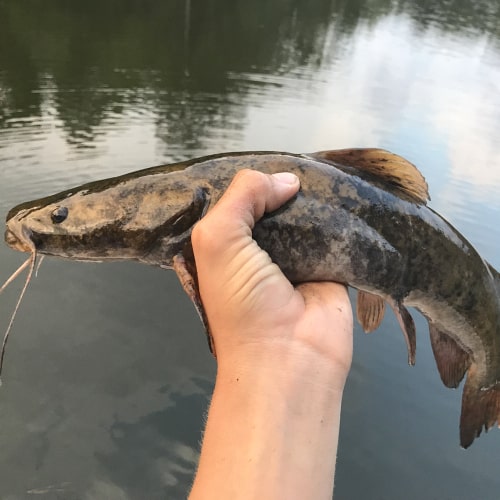
3) Flathead catfish (Pylodictis olivaris)
[su_icon_text icon=”icon: globe” icon_color=”#04629B” icon_size=”30″]Native to North America[/su_icon_text]
Flathead catfish are less abundant in Milford Lake compared to channel catfish, but flatheads can still be found in areas of the lake with rocky or woody coverings. Flathead catfish are generally bigger than channel catfish, with comparable sizes to that of blue catfish. This species is a mottled brown color with a square tail and an underbite.
These fish, like the channel catfish, have barbs on their dorsal and pectoral fins, which are used to poke predators or humans that may have startled them. Flatheads are fierce carnivores, and they typically prey on a variety of fish species such as drum, shad, and other catfish species, including their own. The daily creel limit for this species in Kansas is five fish.
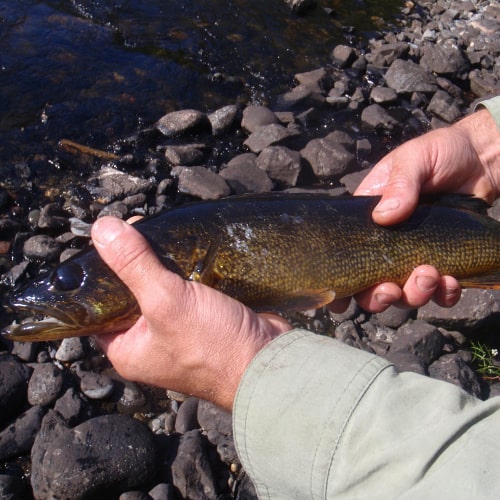
4) Walleye (Sander vitreus)
[su_icon_text icon=”icon: globe” icon_color=”#04629B” icon_size=”30″]Native to North America[/su_icon_text]
Walleye are another popular sportfish in Milford Lake, and they can be found on rocky or wind-swept mud banks or along the dam. This species has a brownish-green body that fades to a cream belly complete with dark horizontal lines. These fish are the largest of the perch family, and they average about 11 pounds.
Walleye get their name from their big, glassy pupils, and these eyes look like this due to a reflective layer on the inner eye called the tapetum lucidum, which helps walleye see prey in times of low visibility. This layer makes walleye sensitive to bright light, however, so they often hunt for their prey, like fishes and mudpuppies, at dusk or night.
Walleye are a stocked species in Milford Lake, and the last stock occurred in May of 2021, when 125,057 walleye were released into the lake. In Milford Lake, the daily creel limit for walleye is two fish, and there is a 21-inch length limit for the fish caught. Currently, the Kansas Department of Wildlife, Parks, and Tourism is conducting a tagging survey on walleye in Milford Lake, so if a walleye that is tagged is caught, the department asks that it be reported.
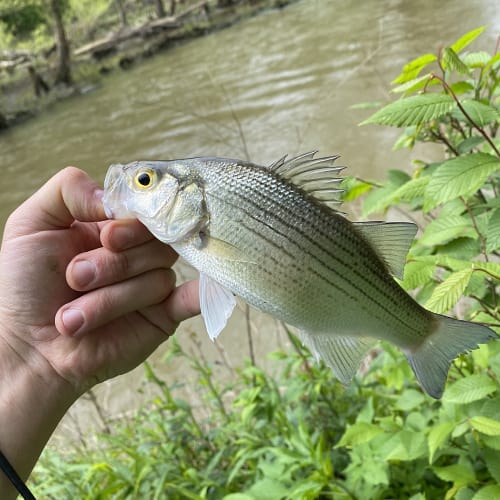
5) White bass (Morone chrysops)
[su_icon_text icon=”icon: globe” icon_color=”#04629B” icon_size=”30″]Native to North America[/su_icon_text]
White bass are commonly found in Milford Lake near windy banks or along the dam since they like faster currents. These fish are a silvery-white color, and they wear 6 – 8 black stripes laterally across their bodies. They have an underbite mouth, much like the largemouth bass; however, white bass are more closely related to striped bass.
White bass are mid-sized fish, and they average about 12 – 14 inches in length and weigh around two pounds. This species is highly aggressive when it comes to feeding and schools of white bass will hunt together for items such as gizzard shad, perch, carp, and other fish species.
6) Hybrid striped bass (Morone saxatilis x Morone chrysops)
[su_icon_text icon=”icon: globe” icon_color=”#04629B” icon_size=”30″]Not native to any area[/su_icon_text]
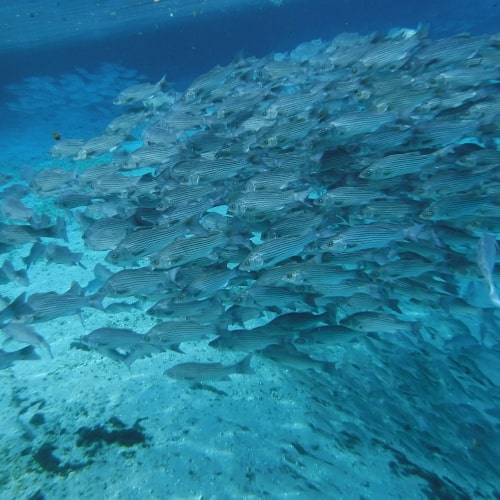
Striped bass hybrids, also known as wipers, are crosses between striped bass and white bass, and they are produced in hatcheries in order to be stocked in bodies of water like Milford Lake. These fish prefer waters similar to that of true striped bass in areas that are cool, clear, and deep. Striped bass hybrids have bodies that are laterally compressed and are silver in color with broken dark horizontal lines. This hybrid also has an arched back, much like white bass, in addition to two tongue patches, which they inherit from the striped bass.
Striped bass hybrids grow very rapidly, and they can reach 18 – 20 pounds by eight years of age. These fish travel in schools and will hunt for items such as shad, minnows, crustaceans, and insects. Wipers are regularly stocked in Milford Lake, and the last stocking event introduced 850,000 wipers in May of 2021. In Milford Lake, there is a daily creel limit of five wipers.
7) Largemouth bass (Micropterus salmoides)
[su_icon_text icon=”icon: globe” icon_color=”#04629B” icon_size=”30″]Native to eastern North America[/su_icon_text]
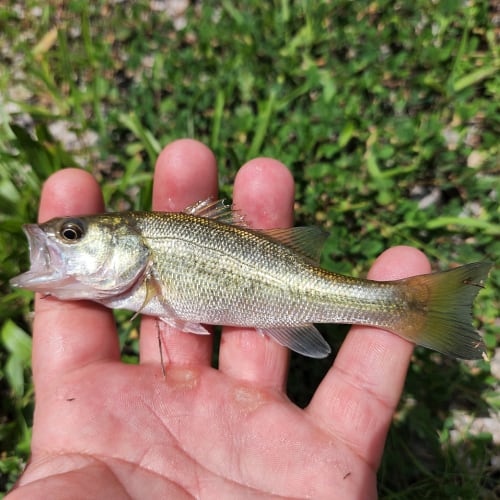
Largemouth bass can be found near coves with vegetation or near other areas with cover in Milford Lake. Largemouth bass get their name from their mouth, which extends past the eye, unlike smallmouth bass. Largemouth bass have olive-green bodies with dark mottling along the back and speckles along the sides.
This species typically grows to about 10 – 15 inches long in Milford Lake and generally weighs 2 – 4 pounds, although the largest largemouth ever recorded was 22 pounds and 4 ounces. Largemouths are carnivores that primarily feed on crayfish but will also eat other fishes and insects.
8) Smallmouth bass (Micropterus dolomieu)
[su_icon_text icon=”icon: globe” icon_color=”#04629B” icon_size=”30″]Native to eastern North America[/su_icon_text]
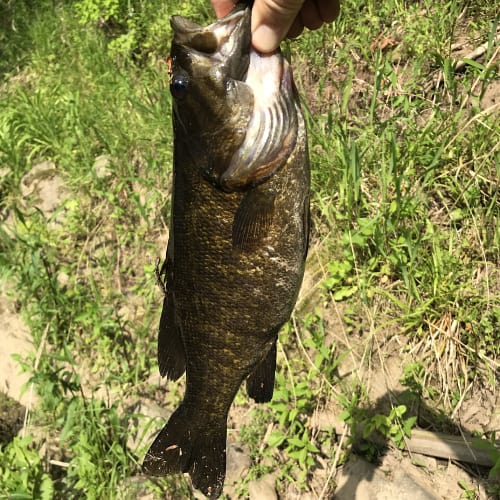
Smallmouth bass are another sportfish in Milford Lake, and they can be found near similar areas as the largemouth bass. Smallmouths are an olive-green color with vertical bands on the side of the body, and they range from 12 – 18 inches in length and weigh around 1 – 4 pounds.
While smallmouth bass look very similar to largemouth bass, the major distinction between the two is that smallmouth bass have a smaller mouth that extends to the midpoint of the eye. Despite the difference in mouth sizes, smallmouths eat a diet similar to largemouth bass. The daily creel limit for black bass species combined in Milford Lake is five fish, and there is a 15-inch minimum length limit for those fish that are caught.
9) White crappie (Pomoxis annularis)
[su_icon_text icon=”icon: globe” icon_color=”#04629B” icon_size=”30″]Native to North America[/su_icon_text]
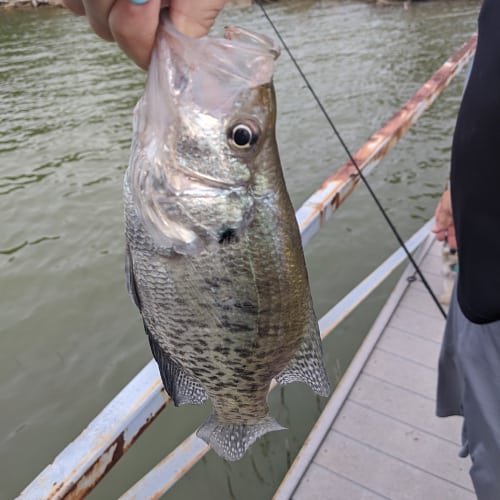
White crappies are a very abundant fish in Milford Lake, and the best chances of finding these fish are in highly vegetated areas where the water is 10 – 20 feet deep. This species has compressed bodies that are silvery olive on the back and silvery white towards the belly. These fish have dark vertical bands along the sides of their bodies, and their gill covers have spines.
During the breeding season, males will look slightly different than females because the males will develop a dark throat. White crappies average about 9 – 10 inches long and are around 2 pounds as adults. These fish generally eat smaller fishes like minnows or shad, but they will also eat insects like mayflies.
10) Black crappie (Pomoxis nigromaculatus)
[su_icon_text icon=”icon: globe” icon_color=”#04629B” icon_size=”30″]Native to North America[/su_icon_text]
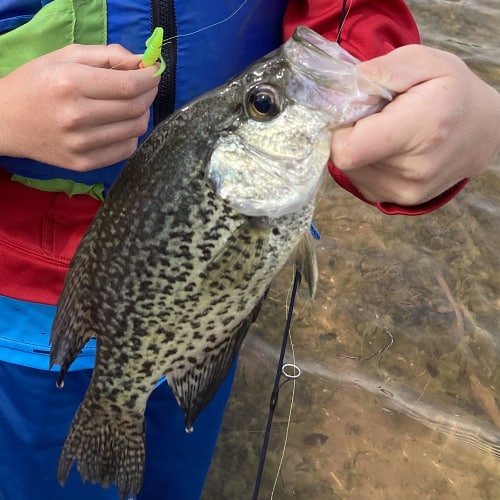
Black crappies are less common in Milford Lake compared to white crappies because they have very specific water conditions, including still clear waters, in order to survive. Black crappies have compressed bodies that are darker green on the back with dark mottling on the silvery sides. They also have 7 – 8 spines on their dorsal fins, which distinguishes them from white crappies, which have 5 – 6 spines.
This species exhibits sexual dimorphism, so the males tend to be larger and darker than the females. Black crappies typically grow to about 8 – 12 inches long and weigh 0.25 – 1 lbs. These fish are able to see relatively well in the dark, so they will generally hunt during the night or early morning for small fish, crustaceans, and insects. There is currently a daily creel limit of 50 crappies in the state of Kansas.
11) Green sunfish (Lepomis cyanellus)
[su_icon_text icon=”icon: globe” icon_color=”#04629B” icon_size=”30″]Native to central North America[/su_icon_text]
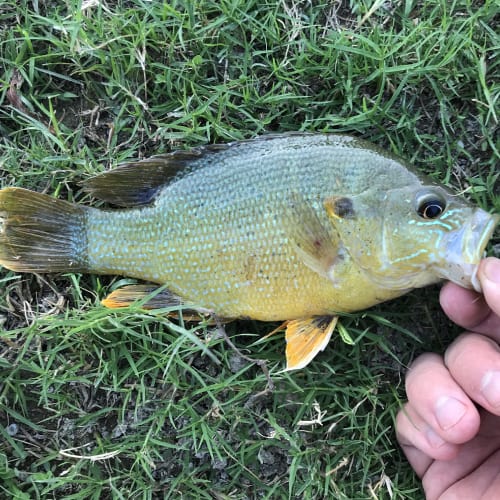
Green sunfish are a widely distributed species due to their tolerance to many different water conditions including high turbidity, low oxygen, and faster moving water; however, these fish are most commonly found around the shores of lakes where there is a lot of cover.
Green sunfish have blueish-green bodies covered in green or yellow reflections and a whitish belly. These fish also have a yellow and green mottled head, a black ear flap, and yellow edges on their fins. This species typically reaches around 3 – 7 inches in length and will rarely weigh over a pound. Green sunfish have very large mouths for panfish, and they use this mouth to eat aquatic insects, crustaceans, and smaller fishes.
12) Bluegill (Lepomis macrochirus)
[su_icon_text icon=”icon: globe” icon_color=”#04629B” icon_size=”30″]Native to North America[/su_icon_text]
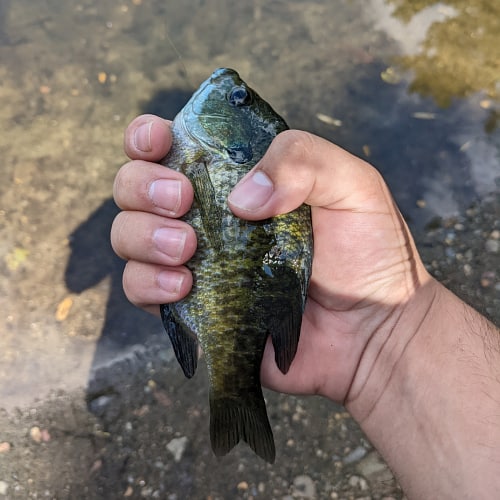
Bluegills are a very common sunfish in Kansas, and they can be found in shallow, vegetated areas of lakes as juveniles, but adults will tend to be in deeper waters during the day. These fish are characterized by having disk-shaped bodies with an olive green back, an orangish-yellow belly, and a black dot at the base of the dorsal fin. Bluegills get their name from the bluish hue surrounding the gill covers.
This species averages around 7.5 inches in length and weighs around half a pound as adults. These fish have very little mouths, so they will only eat smaller prey such as zooplankton, insects, worms, and snails. Bluegills are an important source of food for many larger fish species such as largemouth bass, so they have adapted to be maneuverable. For instance, this species can make very quick stops by spreading out their pectoral fins.
13) Redear sunfish (Lepomis microlophus)
[su_icon_text icon=”icon: globe” icon_color=”#04629B” icon_size=”30″]Native to the central and southern United States[/su_icon_text]
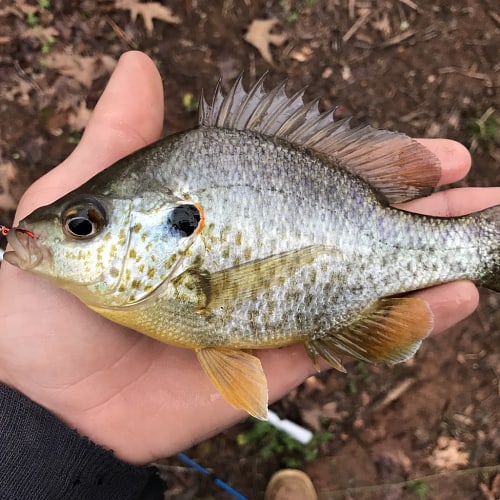
Redear sunfish are found in Milford Lake in areas where the water is warmer and has a moderate amount of cover. These fish have laterally compressed bodies that are usually green, gray, or olive, and they will sometimes have dark flecks and vertical lines along the length of them. Redear sunfish get their name from their black opercular (ear) flap that has a bright red border in males and an orange border for females.
This species can grow up to 12 inches long and generally weigh under two pounds. Redear sunfish are benthic feeders, and once they become adults and develop a strong jaw, they will almost exclusively feed on aquatic snails. These fish are slightly harder to catch compared to bluegills, but they are still willing to bite many kinds of bait, which makes sunfish a perfect starter fish for new anglers.
14) Freshwater drum (Aplodinotus grunniens)
[su_icon_text icon=”icon: globe” icon_color=”#04629B” icon_size=”30″]Native to North America[/su_icon_text]
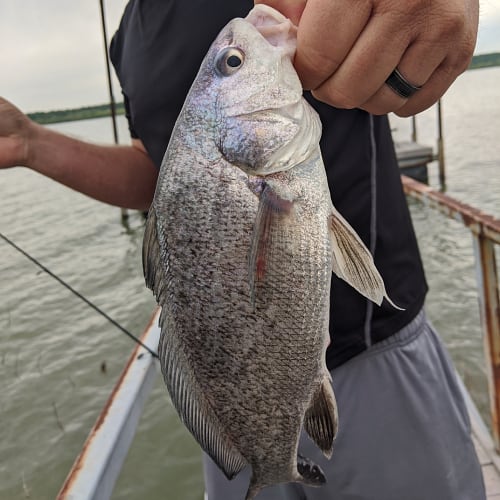
Freshwater drum, also known as sheepshead, is a fish that will most likely be found in shallow, muddy waters of Milford Lake. This species gets its name from the drumming or croaking noise males can make with a specific muscle in their body to attract mates. Freshwater drums are characterized by their silver bodies with a lateral line that extends all the way through their caudal fin. They also have a steeply sloping body that gives them the appearance of having a humpback.
This species averages about 10 – 14 inches long and will usually weigh up to five pounds. Drum have large teeth that help them eat a variety of prey at the bottom of the lake including snails, insects, small fish, and invasive zebra mussels that can be found throughout Milford Lake.