
Your koi are domesticated ornamental carp in the family Cyprinidae, commonly classified today as Cyprinus rubrofuscus, the Amur carp. You will also encounter Cyprinus carpio and older subspecies names because carp taxonomy and breeding history have produced overlapping naming traditions.
Understanding koi classification clarifies where these popular ornamental fish belong. As a form of domesticated carp, koi fish are celebrated across the world for their striking colors.
When you call your fish koi, koi carp, or nishikigoi, you are using names associated with ornamental carp. Nishikigoi means “brocaded carp,” a reference to their decorative coloring.
Whether kept in garden koi ponds or a specialized backyard koi pond, their visual appeal is undeniable. You encounter a different classification system when you compare koi varieties.
Names such as Kohaku and Showa describe appearance within domesticated koi. Keeping scientific identity separate from color and scale labels makes both systems easier to use.
Are Koi Common Carp or Amur Carp?
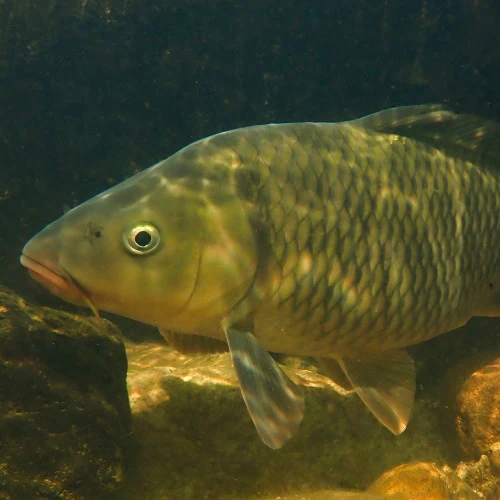
For a current scientific designation, you can use Amur carp, Cyprinus rubrofuscus, while recognizing that common carp terminology remains widespread. You will find koi classified as Cyprinus rubrofuscus by the USGS, alongside historical names and an explicit acknowledgment of their complicated ancestry.
Where Do Koi Fit in the Scientific Taxonomic Hierarchy?
As a freshwater fish, you place koi in the carp and minnow family. Following the ITIS hierarchy, your classification runs through these ranks:
- Kingdom: Animalia
- Phylum: Chordata
- Subphylum: Vertebrata
- Superclass: Actinopterygii, the ray-finned fishes
- Class: Teleostei
- Order: Cypriniformes
- Family: Cyprinidae
- Genus: Cyprinus
- Species designation: Cyprinus rubrofuscus
You will find Cyprinus rubrofuscus recognized as a valid species in ITIS. Some classification systems arrange the higher fish ranks differently, so your most useful reference points are the family, genus, and species.
If you compare koi and goldfish, you encounter two members of Cyprinidae with different genus assignments: Cyprinus for koi and Carassius for goldfish. Shared family membership establishes a relationship; your fish’s genus gives you a narrower identification.
Why Do Sources Use Different Scientific Names for Koi?
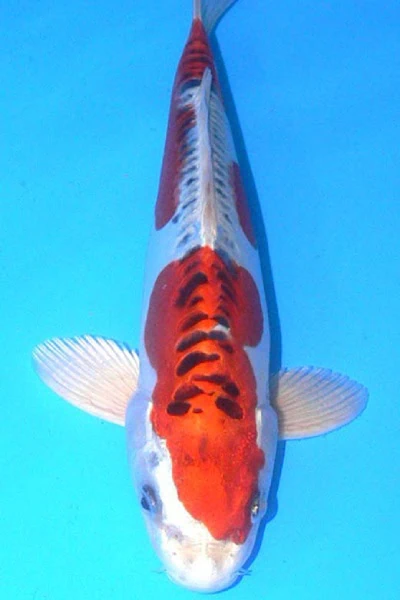
You encounter different names because taxonomists have treated European and East Asian carp populations differently over time. Older classifications grouped them under common carp, Cyprinus carpio, with regional forms assigned subspecies names.
Under this traditional model, taxonomists divided Cyprinus carpio into three geographic subspecies:
- Cyprinus carpio carpio: Endemic to Europe.
- Cyprinus carpio haematopterus: Endemic to Northeast Asia.
- Cyprinus carpio viridiviolaceus: Endemic to Southeast Asia, native to regions such as Vietnam.
In recent scientific literature, East Asian common carp populations are classified under Cyprinus rubrofuscus. However, the older tripartite subspecies system remains widely referenced in breeding and veterinary literature.
How Did Selective Breeding Produce Japanese Koi?
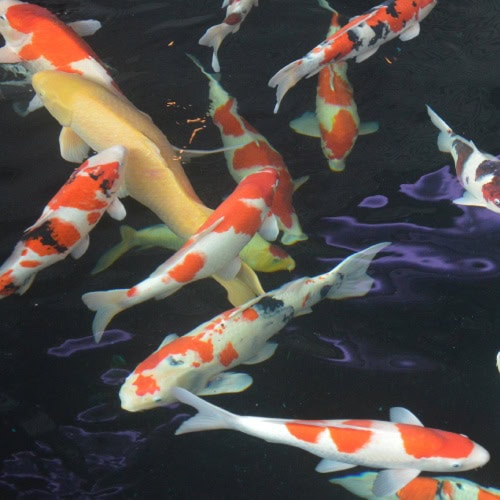
You can trace modern Japanese koi development to selective breeding in nineteenth-century Niigata, Japan. Carp had a much longer history of cultivation in East Asia, including China, before Niigata breeders developed the ornamental tradition associated with nishikigoi.
Among the facts about koi that explain their appearance, selective breeding is central: breeders retained unusual coloration and paired fish to develop recognizable patterns over generations. Later koi breeding refined those patterns and introduced additional scale forms and finishes.
Breeders developed early nishikigoi primarily from color mutations in C. carpio haematopterus. These early stocks arose from magoi lines, specifically Asagi Magoi, Tetsu Magoi, and Doro Magoi.
Although magoi is sometimes translated loosely as “black carp,” the separate fish species known as black carp is Mylopharyngodon piceus.
Over time, the nishikigoi gene pool incorporated other subspecies strains. Crosses with German mirror carp (C. carpio carpio) introduced the reduced scale patterns found in Doitsugoi.
Breeders also introduced Indonesian carp (C. carpio viridiviolaceus), resulting in long-finned Hirenagagoi. These foreign strains contributed distinct scale and fin characteristics to modern koi varieties.
How Are Koi Varieties Identified?
You identify koi varieties by examining their ground color, markings, scale arrangement, and surface sheen. Japanese labels combine these visible characteristics, while show organizations group the resulting varieties into classes that differ between classification systems.
What Distinguishes Kohaku, Sanke, and Showa?
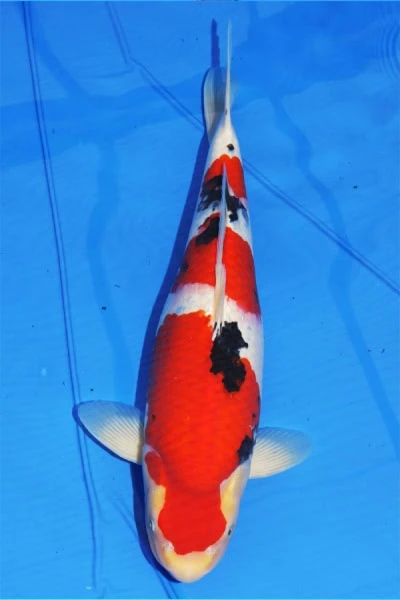
You recognize the Gosanke as Kohaku, Taisho Sanke, and Showa Sanshoku. Their shared vocabulary gives you a useful starting point: hi means red, sumi means black, and shiroji refers to the white ground.
When you examine a Kohaku, look for red patterning over white skin. Sanke adds black accents to a white-based fish, while Showa carries a stronger black pattern that extends around the body.
| Identification feature | Kohaku | Taisho Sanke | Showa Sanshoku |
|---|---|---|---|
| Traditional ground | White | White | Black |
| Main colors | Red and white | White, red, black | Black, red, white |
| Black pattern | Absent | Separate accents | Broad, wrapping areas |
| Head markings | Red over white | Traditionally clear of black | Black commonly present |
You get the clearest Sanke-versus-Showa distinction by following the structure of the sumi. On Sanke, black reads as discrete markings along the upper body; on Showa, it forms larger connected areas extending down the sides.
Treat the head marking as a useful clue within that larger pattern. Young koi develop as they grow, and modern Showa sometimes carry extensive white, so a single patch gives you less information than the whole fish.
How Do Other Varieties Differ in Color and Pattern?
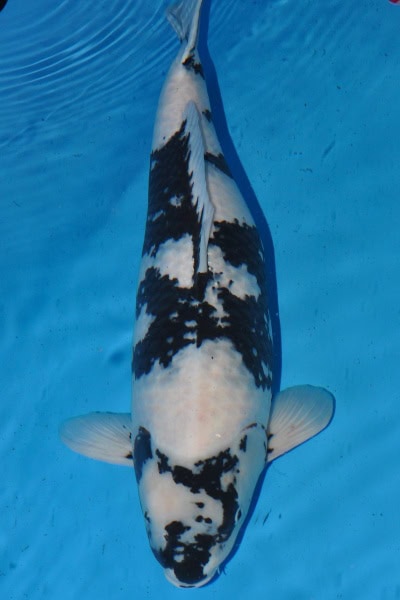
Beyond Gosanke, you can narrow an identification by following the placement of black and the appearance of individual scales. These features help you distinguish fish that share similar colors.
- Utsurimono: You see a black-based pattern paired with white in Shiro Utsuri, red in Hi Utsuri, or yellow in Ki Utsuri. “Utsuri” also appears as shorthand within these names.
- Bekko: You see separate black markings over a white, red, or yellow body. In a classic example, the head remains clear of black.
- Asagi: You look for blue-gray netlike scaling across the back, with red along the lower sides and on parts of the fins.
- Shusui: You recognize the reduced-scale counterpart of Asagi through smooth blue skin and prominent dark scales along the back.
- Koromo: You see a Kohaku-like pattern with darker edging or overlay within the red markings. Ai Goromo is a familiar example.
- Goshiki: You look for red patterning against a reticulated ground that develops a gray, blue, or dark appearance.
- Chagoi: You recognize tea-colored or brown coloration, often with visible netlike scale definition.
When comparing black-and-white koi, your most useful distinction between Utsurimono and Bekko is the black pattern’s structure. Broad wrapping areas indicate Shiro Utsuri; separate black spots over a white ground indicate Shiro Bekko.
You will also encounter Kawarimono, a broad nonmetallic category for koi outside other established groups. Your show’s classification rules determine how particular varieties are grouped, so a fixed category count is less useful than the fish’s identifying traits.
What Do Doitsu, Gin Rin, and Metallic Labels Mean?
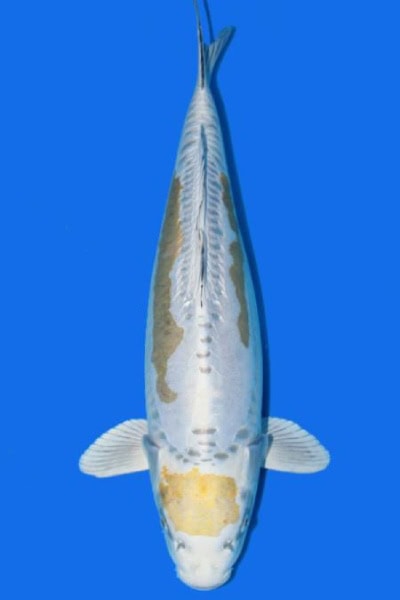
You read these labels as descriptions of scales or finish that combine with a variety name. A longer name frequently gives you several layers of identification.
With Doitsu, also called Doitsugoi, you are looking at German-derived scale forms: nearly scaleless fish or fish carrying limited rows of large scales. In Shusui, that scale arrangement is part of the variety’s established identity; in Doitsu Kohaku, it modifies the Kohaku description.
Gin Rin identifies a sparkling reflective effect in individual scales. You will also encounter Kin Rin and the combined term Kinginrin, associated with gold- and silver-like scale reflections. Your viewing angle changes how strongly those scales flash.
With metallic koi, you look for a broader lustrous finish across the skin and fins. Ogon identifies single-color metallic koi. A solid Ogon koi like the Platinum Ogon presents a lustrous white look, distinct from the localized sparkle of Gin Rin scales.
Tancho describes a red marking confined to the head, ideally rounded, with no additional red on the body. You therefore encounter combinations such as Tancho Kohaku or Tancho Showa, with the remaining pattern determining the underlying variety.
Are Koi Breeds Separate Species?
You should interpret “koi breeds” as informal language for ornamental varieties within domesticated koi. Kohaku, Chagoi, and the other named forms occupy the hobbyist classification level.
Your variety label describes inherited appearance, and koi of different varieties interbreed. Their offspring require individual assessment because parental names do not guarantee a matching pattern in every youngster.
When you record a fish’s identity, keep the layers separate: use Cyprinus rubrofuscus for the scientific designation, then add the variety and applicable modifiers. For example, “Gin Rin Kohaku” tells you to expect a red-and-white Kohaku pattern with reflective scales.