
Imagine a floating lily pad so massive you could comfortably lie down on it for an afternoon nap. That is not science fiction or movie CGI – it is Victoria boliviana, the undisputed largest water Lily of the plant world!
In the wild, its colossal green circular pads stretch over 2.8 meters (9 feet 2 inches) across. Its blooms open up to 36 centimeters (14 inches) wide, easily dwarfing a standard car steering wheel.
These mind-boggling dimensions earned it the official Guinness World Record for the largest waterlily species. It is even capable of supporting over 80 kilograms (176 pounds) if weight is evenly distributed across its buoyant surface.
Largest Water Lily in the World?

While the entire species is gigantic, one particular specimen took nature’s boundaries to a whole new level.
On February 3, 2012, horticulturists at the breathtaking La Rinconada Gardens in Santa Cruz, Bolivia, measured a record-shattering leaf that spanned 3.2 meters (10 feet 6 inches) across. That single pad snagged two world records: largest waterlily leaf and largest undivided leaf known on Earth.
Unlike common garden water lilies in the genus Nymphaea, which stay modest in size, these river titans look like floating banquet platters with high, upturned rims.
Those rim walls are not just for show. They prevent neighboring plants from encroaching, while tiny slit-like notches act as built-in drainage spouts so heavy tropical downpours do not sink the pad.
How It Stacks Up Against the Competition
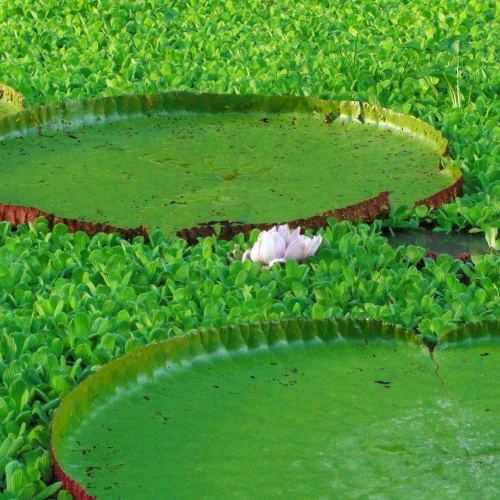
For more than a century, botanists believed only two giant water lily species ruled South American waterways. Here is how Victoria boliviana stacks up against its famous botanical siblings:
| Feature | V. boliviana | V. amazonica | V. cruziana |
|---|---|---|---|
| Floating pad width | Over 2.8 m (9+ ft) | Up to 2.3 m (7.5 ft) | Up to 2.4 m (7.9 ft) |
| Flower width | Up to 36 cm (14 in) | Up to 28 cm (11 in) | Up to 30 cm (12 in) |
For decades, Victoria amazonica was hailed as the undisputed monarch of tropical waters. But keen observers noticed that Bolivia’s wild populations produced vastly larger leaves, distinctly shaped seeds, and unique flower structures.
Side by side, the newly recognized champion outgrows both sister species by nearly two full feet in diameter.
Hiding in Plain Sight for Over a Century
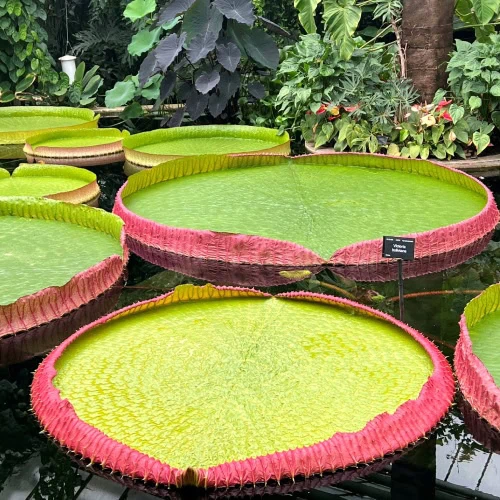
How did the world’s biggest water lily stay unrecognized by modern science for 177 years? Believe it or not, it was hiding in plain sight in famous botanic gardens and pressed herbarium sheets around the globe!
Botanists had simply assumed these massive specimens were unusually vigorous examples of Victoria amazonica. It took a dedicated detective effort to finally crack the mystery.
In 2016, Bolivian institutions sent wild seeds to the Royal Botanic Gardens, Kew, in London. Kew horticulturist Carlos Magdalena immediately noticed that the young seedlings grew differently than any water lily he had ever seen.
Teaming up with botanical artist Lucy Smith and Bolivian scientists, Magdalena ran rigorous tests. A landmark 2022 study in Frontiers in Plant Science confirmed that its DNA was completely distinct, officially naming it as Earth’s third giant water lily species.
Wild Habits and Night-Blooming Magic
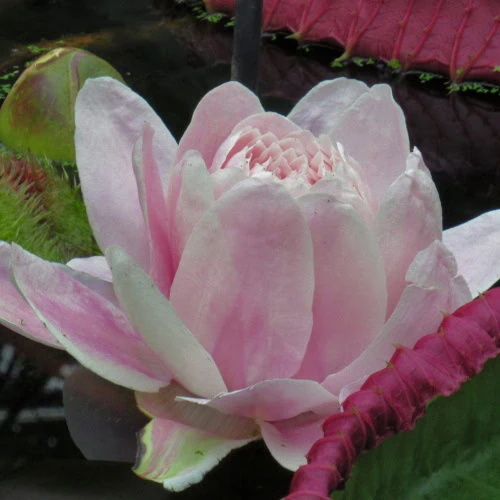
In the wild, Victoria boliviana thrives in the freshwater wetlands and seasonal floodplains of the Llanos de Moxos in Beni Department, northern Bolivia.
Underneath each tranquil leaf lies an armored fortress. A complex scaffolding of air-filled ribs reinforces the pad, while sharp, menacing spines cover the entire underside to deter hungry fish, manatees, and aquatic herbivores.
Its flowering behavior is pure botanical theater. The blossoms open strictly at dusk on their first night, glowing brilliant white and releasing a warm, pineapple-like fragrance.
This scent and floral heat attract scarab beetles into the flower’s core. As dawn arrives, the petals close tightly, trapping the beetles inside for the day.
By the second evening, the flower reopens, having changed color to a vibrant pinkish-purple. Coated in fresh pollen, the released beetles fly off to pollinate another white blossom, completing an ingenious reproductive cycle.
Is This Gentle Giant in Trouble?
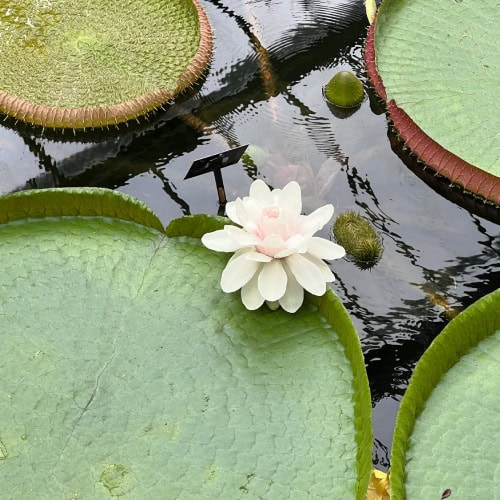
Because Victoria boliviana is restricted to a relatively small geographical basin in Bolivia, scientists are keeping a close watch on its future.
There is currently an active discussion about its conservation standing. While Wikipedia notes it as Least Concern, the research team that formally described the species warned it qualifies as Vulnerable or even Endangered.
Its wetland habitat faces growing pressures from agricultural expansion, cattle ranching, and seasonal droughts intensified by regional climate shifts.
Ongoing conservation work and seed-banking programs are now racing to safeguard these wild populations. Preserving this living marvel ensures that future generations can marvel at the floating green giants of the Bolivian wetlands.