
Yes, you can have too much aeration in a pond: excessive circulation or abrupt mixing can stress fish, stir sediment, and disrupt suitable water temperatures. With ordinary backyard pond aeration, your main concern is how the equipment moves water (.e.g., strong currents), as oxygen toxicity is almost impossible with proper operation.
In a shallow pond, over-aeration problems center on strong currents and disturbed muck, rather than too much oxygen. In a deeper pond with separate warm and cool layers, starting a powerful aerator abruptly carries an additional risk: mixing oxygen-poor bottom water into the water your fish occupy.
What Can Go Wrong When Aeration Is Mismanaged?
You risk harming pond life when circulation spreads oxygen-poor water, removes suitable cool habitat, or keeps sediment suspended. Your equipment and pond conditions determine which risks deserve attention; visible bubbles alone cannot diagnose over-aeration.
How Can Sudden Mixing Trigger Fish Kills?

A very deep pond can develop thermal stratification during warm, calm weather. You get warm surface water above cooler bottom water, with a temperature-transition zone called the thermocline between these thermal layers.
Your bottom water loses oxygen as organisms consume it and decomposition continues. When you start a deep diffuser at full output after stratification has developed, you bring that depleted water upward while mixing oxygenated surface water downward.

This thermal destratification becomes dangerous when mixing spreads low oxygen faster than aeration replenishes it. Your fish then lose their oxygen-rich refuge. During a severe turnover, oxygen throughout a pond can fall too low for fish to survive.
Your risk is greatest when a substantial volume of deep water has remained isolated and oxygen-poor. A shallow ornamental pond with little temperature layering presents a different management problem, so you should base startup decisions on depth measurements and water testing.
When Does Mixing Remove Cool-Water Refuges?
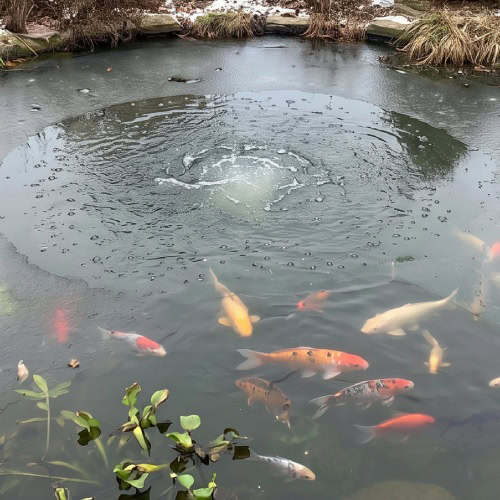
If you keep trout or other cold-water fish, full-depth mixing deserves particular care during summer. You redistribute surface heat downward when you circulate the entire pond, potentially warming the deeper water your fish use.
Your cool-water refuge must also contain enough oxygen. A cold bottom layer with depleted dissolved oxygen provides unsuitable habitat, even when its temperature looks favorable.
Measure water temperature and oxygen together at several depths before changing circulation. If your surface water is already too hot for your pond fish, increasing full-depth mixing deserves a species-specific assessment.
For a cold-water fishery, you might need a circulation layout that preserves usable cool habitat or specialized oxygenation that limits mixing. You should establish that approach with a fisheries professional because ordinary bottom aeration is designed to circulate water.
Can Strong Currents and Stirred Sediment Harm Pond Life?
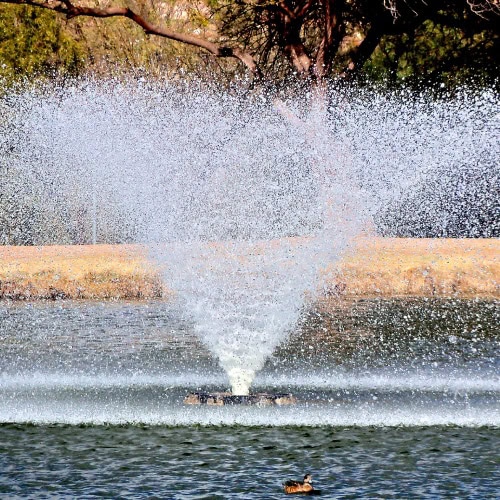
You create a local current problem when fish must swim continuously to hold position or struggle to reach food. In a small fish pond, watch whether your fish have calmer areas where they swim and rest normally.
A diffuser resting in soft muck creates another problem: sediment resuspension, meaning settled particles return to the water. Your water becomes cloudier, and nutrients lifted from the bottom potentially fuel algal blooms. You also risk shoreline erosion when powerful circulation reaches an unprotected bank.
Check your diffuser placement if a muddy plume appears whenever the compressor starts. To reduce pond-water turbidity, address the disturbance before adding clarifiers. A stable diffuser base or raised support helps keep the air outlet clear of loose sediment.
You should also distinguish bubbles from persistent pond-water foam. Aeration concentrates dissolved organic material into visible froth, so lingering foam warrants a check for excess feed and decaying debris.
How Rare Is Gas Bubble Disease?
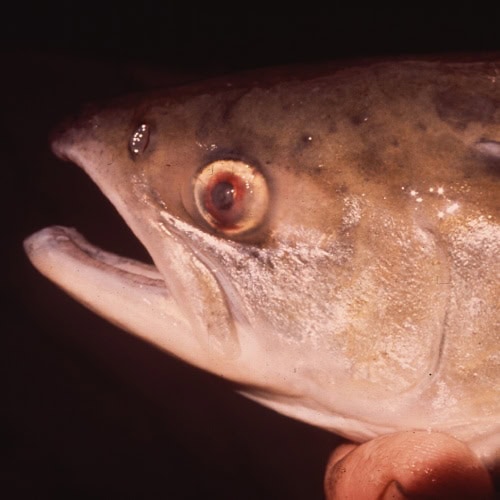
You are unlikely to encounter gas bubble disease from a typical backyard pond air pump or surface aerator. Your concern becomes more relevant with unusual pressurized arrangements, air leaks on pump suction lines, or incoming water carrying excess dissolved gas.
Gas supersaturation means your water contains more dissolved gas than its equilibrium level under the surrounding conditions. With sufficient excess total gas pressure, bubbles form inside fish tissues or blood vessels, causing gas bubble disease.
Ordinary surface aeration exchanges gas with the atmosphere. If your water is already oxygen-supersaturated, that exchange releases oxygen back into the air. Deep diffusers operate under different pressure conditions, but vigorous bubbling by itself gives you no diagnosis of harmful supersaturation.
If you notice bubbles within fins or around the eyes, obtain a fish-health assessment. Your dissolved oxygen meter alone cannot diagnose total gas supersaturation; that requires suitable gas-pressure testing.
How Do You Adjust Aeration Without Depriving Fish of Oxygen?
Adjust your aeration using fish behavior and measured water quality, while maintaining oxygen support wherever fish are struggling. Your pond management approach should separate emergency oxygen delivery from routine circulation and gradual startup.
Which Warning Signs Call for Water Testing?

- Contains one (1) API POND MASTER TEST KIT Pond Water Test Kit 500-Test, including 6 bottles of testing solution, 3 color cards and 4 test...
- Helps monitor water quality and prevent invisible water problems that can be harmful to fish
- Measures ornamental pond pH balance, Ammonia content, Nitrite levels and Phosphate content

Test promptly if you notice fish gulping at the surface, gathering around an inflow, refusing food, or becoming unusually sluggish. Pay particular attention around sunrise, after an algae die-off, and following equipment changes.
Start with dissolved oxygen and temperature. For largemouth bass and bluegill, you should aim for dissolved oxygen above 5 mg/L; concentrations of 2 mg/L or lower threaten rapid suffocation. Your species and water temperature determine the appropriate operating target.
For a useful picture of your fish pond:
- Measure near dawn to check the overnight oxygen low.
- Compare an afternoon reading to identify the daily swing.
- Sample several locations, including an area away from the aerator.
- Check surface and deeper water separately where depth permits.
- Record the readings alongside equipment settings and fish behavior.
Include pH, ammonia, and nitrite when fish remain distressed despite adequate oxygen. If testing identifies elevated ammonia, address feeding and filtration as part of lowering ammonia in your fish pond.
Treat gasping as urgent. Maintain or add effective surface aeration while investigating, and avoid suddenly mixing additional oxygen-poor bottom water into the occupied zone. Pause feeding during the oxygen emergency.
How Should You Size and Position a Pond Aerator?
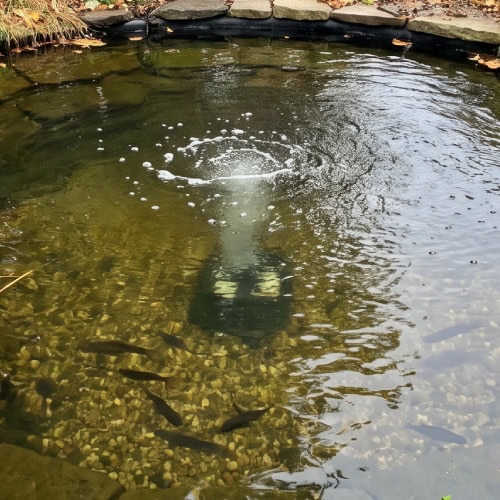
Size your pond aerator around oxygen demand and the water you need to circulate. Surface acreage alone leaves out depth, pond shape, fish biomass, feeding rate, and organic loading.
For a small ornamental pond, your koi pond aerator system should provide useful circulation while leaving calmer swimming areas. A larger recreational pond with separate coves needs a layout that reaches those areas without concentrating all movement at one outlet.
With a diffused aeration system, match compressor output to operating depth and the diffuser’s specified airflow range. Fine-bubble diffusers provide substantial bubble surface area, but fouling reduces performance and calls for cleaning.
Keep your diffuser stable and clear of loose sediment. Placing an air outlet directly in soft bottom material stirs sediment and releases nutrients into the water.
You do not need a universal diffuser-depth rule or a fixed pond-turnover limit. Use the equipment’s performance information and your pond’s measured temperature and oxygen profile to set placement.
How Do You Start or Restart Aeration Gradually?

- Aquascape 2-Outlet Pond Aeration Kit, Quiet Energy-Efficient Pond Aerator with Weighted Air Stones, Airline, Check Valves, for Ponds up to...
- Oxygenates Ponds: 2-outlet pond aeration kit helps keep water healthy, clean, and clear by supporting oxygen levels in ponds up to...
- Complete Aerator System: Includes two weighted 4-inch aeration discs, two 25-foot rolls of 3/16-inch silicone airline, and preassembled...
Use your manufacturer’s startup procedure when introducing diffused aeration into an established pond. Give a restart after an extended warm-weather shutdown the same attention, since your pond might have developed fresh stratification.
Before startup, measure temperature and oxygen down the water column. If you find oxygen-rich surface water over depleted bottom water, begin with the manufacturer’s staged operating periods and check conditions between increases.
You avoid much of this startup difficulty by establishing circulation before seasonal stratification develops. Once your system is operating, continuous circulation during warm weather prevents thermal layers from reforming.
If fish show distress during startup, stop advancing the schedule. Maintain oxygenated surface habitat and reassess the deeper mixing. A universal instruction to double runtime every day ignores differences in your pond’s oxygen demand and the amount of depleted water below.
When Should You Adjust Airflow or Runtime?
Reduce localized airflow when testing shows adequate oxygen but your aerator creates persistent sediment plumes or leaves fish struggling against currents. Where possible, redistribute air among properly positioned diffusers while keeping each outlet within its rated range.
Your runtime should match the job:
- For supplemental oxygen: Use overnight and near-dawn readings to determine when support is needed.
- For preventing stratification: Maintain continuous operation through the stratification season after a safe startup.
- After an outage: Check for renewed layering before resuming full-depth circulation.
- During winter: Reassess placement and operation for your climate and fish population.
If you are keeping pond fish alive through winter, preserve suitable deeper habitat while maintaining needed gas exchange. Aeration also weakens nearby ice, so keep people and pets away from the affected area.
Change one setting at a time and record the result. After reducing airflow or shortening an oxygen-support schedule, recheck dissolved oxygen near dawn and watch whether fish retain normal swimming and feeding behavior.