
When you see blue koi fish for sale, you’re looking at a color description, not a single named variety. An Asagi’s blue-gray back has a fine netted pattern, a Shusui has smooth sides and a line of scales along its back, and a blue butterfly koi has long, flowing fins.
The blue you see is usually closer to slate or pale blue-gray than neon. In the realm of ornamental koi, these subtle tones developed through generations of selective breeding. That distinction helps you judge a fish’s appearance without paying for a color you may never see in your pond.
Are Blue Koi a Distinct Variety?

Blue koi describes coloration found in several Japanese koi varieties. You identify Japanese koi fish by their pattern, scales, and body form as well as their color; “blue” alone tells you little about which variety you’re viewing.
Through careful selective breeding, Japanese koi have expanded into dozens of recognizable lineages. While popular varieties like the brownish Chagoi or hybrid ghost koi feature earthy or metallic tones, blue koi remain prized among classic ornamental koi varieties.
What Shades of Blue Can Koi Actually Have?
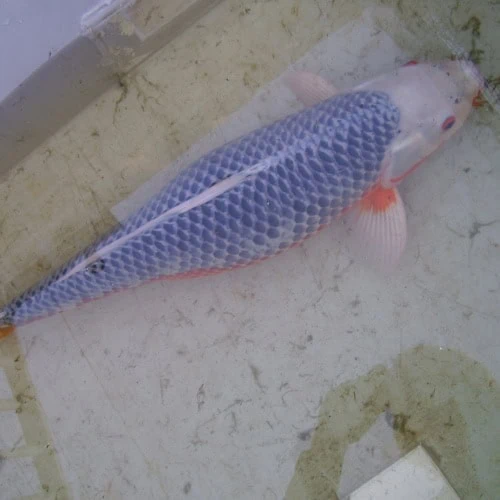
You can expect tones ranging from light blue-gray to deeper slate or indigo. On a traditional Asagi koi, darker edges around pale scales give the back its netted appearance. Red markings may add contrast along the sides and fins.
Treat vivid electric-blue listing photos with caution. When you compare koi fish colors, look for a clear view of the whole fish in ordinary light, including its back, head, and sides. A young koi’s color and pattern can also change as it grows.
Why Can the Same Fish Look Different in Photos and Ponds?

You’ll see different shades as light, viewing angle, water depth, and background change. A pale back can look brighter in a shallow viewing bowl and darker beneath the surface of an outdoor pond. Camera settings can shift blue-gray toward turquoise.
If you’re choosing from photos, ask for a current video of the fish swimming and turning. It gives you a better view of the pattern on both sides and shows how the fish carries its fins.
How Can You Identify Blue Koi Varieties?
Start with the scales and fins: Asagi has a netted, fully scaled back; Shusui has smooth sides with a dorsal scale line; butterfly koi have extended fins. These features remain useful when the shade of blue is hard to judge.
Asagi: Netted Blue Scales and Red Accents

You can recognize Asagi koi by the regular, mesh-like pattern across the blue-gray back. Red commonly appears on the cheeks, at the pectoral fin joints, and along the sides below the lateral line. A clean, lightly colored head lets that back pattern stand out.
Look at the spacing of the netting from shoulder to tail. Uneven color does not make an Asagi koi unhealthy, but it affects the pattern you’ll see from above. A breeder’s description of Asagi markings identifies the blue reticulation and placement of the red accents.
Shusui: Smooth Sides and a Blue Dorsal Scale Line

With Shusui koi, your eye goes to the orderly, blue zipper-like scales running along the back. The sides are largely scaleless, so you see broad areas of pale blue or blue-gray without Asagi’s all-over netting.
Check whether the dorsal scales look neatly aligned when the fish swims straight. Red appears on the sides and fins and can extend above the lateral line. Smooth skin and an even scale line are useful identification details, though you should judge health separately from show-style pattern.
Blue Butterfly Koi: Color with Long, Flowing Fins
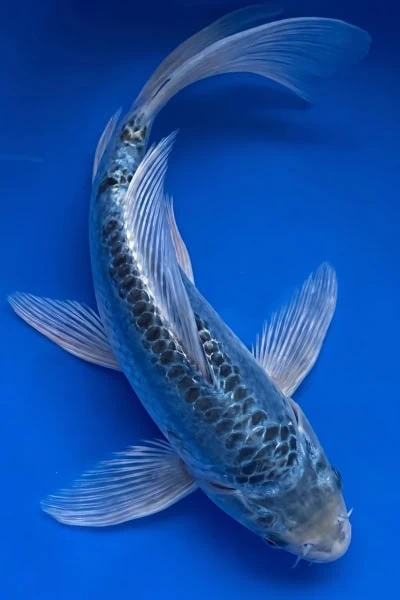
You identify a blue butterfly koi by its extended pectoral fins and long tail, paired with blue or blue-gray coloring. “Butterfly” describes fin form, so a long-finned fish can also show an Asagi or Shusui pattern.
Watch the fish swim before judging the fins from a still image. The fins should open freely and look intact; splits, clamping, or frayed edges deserve a closer health check. Their length also makes fin damage easier for you to spot.
What Should You Check Before Buying?
Check the individual fish’s health, current appearance, and the seller’s description before you weigh its color or price. Listings for koi fish for sale vary widely, and exciting koi fish colors should never distract you from checking body shape and vigor. A label such as “rare blue” does not tell you the variety, grade, or condition.
How Much Does a Blue Koi Fish Cost?
You may see ordinary pond koi priced from about $20 to $500 or more, a broad range for koi generally, not a blue-specific price schedule. Blue koi fish cost changes with size, pattern quality, fin condition, breeder, and whether you’re looking at a young pond fish or a show prospect. Shipping and quarantine equipment add to your initial expense.
Compare your selection with others of similar size and variety. A neatly patterned Asagi often commands more than a less even one, though striking blue-gray fish remain affordable. If you’re budgeting, koi price factors and realistic blue koi fish cost estimates are far more useful than the word “blue” in a listing.
How Do You Assess Color, Health, and Seller Claims?

Ask for recent, unfiltered images and a video if you cannot see the fish in person. Check the variety name against its scales and fins, and compare the blue against white koi or a neutral background in the same lighting. If a seller names a breeder such as Kloubec Koi Farm, ask which fish the claim applies to and what documentation accompanies it.
You want clear eyes, smooth skin, open fins, and steady swimming. Pass on a fish that gasps at the surface, holds its fins tight, or shows sores; inspect its tankmates too. Ask how long the seller has held the fish and what quarantine and health checks it has received.
What Does a Blue Koi Need in Your Pond?
Your blue koi needs the same roomy, filtered, oxygenated water as any other koi. Its color gives you no shortcut on pond size or maintenance, whether you keep it in a dedicated koi pond or a planted water garden.
How Much Space and What Water Quality Does It Need?

- Professional-Grade Performance and Durability: Engineered for performance and durability, this high-capacity pond pump is the go-to choice...
- Energy-Efficient Asynchronous Motor: The asynchronous motor provides powerful yet energy-efficient operation, saving on electricity while...
- Versatile Installation Options: Designed for horizontal or vertical placement, the compact body fits in skimmers and waterfall filter...

Plan around the adult fish, not the size in the listing. A pond holding at least 1,000 gallons with an area 3 to 4 feet deep is a useful starting point; stocking must still fit your filtration and the fish already living there. For a smaller outdoor pond, work through how many koi your pond can support before adding another fish.
In outdoor water gardens, testing ammonia and nitrite for 0 ppm is critical, along with keeping pH stable. Mechanical filtration removes debris, while biological filters process fish waste; aeration helps in warm weather.
If your water garden also holds goldfish or energetic ghost koi, count their waste load and feeding needs when you assess capacity. Clear-looking water alone does not establish safe water quality.
How Should You Introduce a New Koi?

- Contains one (1) API POND MASTER TEST KIT Pond Water Test Kit 500-Test, including 6 bottles of testing solution, 3 color cards and 4 test...
- Helps monitor water quality and prevent invisible water problems that can be harmful to fish
- Measures ornamental pond pH balance, Ammonia content, Nitrite levels and Phosphate content
Keep a new koi in a separate, filtered and aerated quarantine setup for several weeks before it joins your pond. Observe its appetite, swimming, skin, and fins while you test the quarantine water. Keep equipment separate so water from the holding setup does not enter your established pond.
When quarantine is complete, compare the holding water’s temperature and chemistry with the pond’s and make the transition gradually. After release, watch the newcomer feed and swim among its koi pond mates. Placid pond companions like a Chagoi often help nervous new fish settle in quickly.
Test the main pond’s water again as its filter takes on the additional waste.